Posts

Cook County Finally Agrees: Live Music and DJ Sets ARE Art

Screen Shot 2016-10-14 at 4.01.26 PM

Back in August, Cook County, which also includes the city of Chicago, attempted to pass a new law that to ensure that rock, rap and electronic music were not seen as art in the eyes of the taxman.

The goal was to levy a tax on small venues in the county that feature live music. If approved, the legislation would have required establishment to pay heavy back-taxes and fines, as well as taxes in the years to come — an economic burder that would have crushed the finances of most venues and driven them out of business.

Today however, Cook County Commissioner John Fritchey announced that an agreement has been reached to change the rule in question so that live music and DJ sets are in fact considered an art form. Other local key officials have agreed with the Commissioner, including local Cook County Board President Toni Preckwinkle’s administration, representatives from the City of Chicago, and industry stakeholders. The official hearing on the amendment to the county’s amusement tax ordinance will take place October 26.

In the official press release Fritchey stated, “This agreement makes it clear that it was never the intent of the Administration for the County to play culture police and make decisions on what is, or isn’t, music or art, and that fact is bolstered by President Preckwinkle’s desire to co-sponsor my amendment. By bringing together public officials and music industry representatives, we were able to arrive at language that all parties agree recognizes the diverse and robust nature of live music while providing the County with the ability to collect those taxes that are legitimately owed to it.”

Metro and Smartbar owner Joe Shanahan weighed in happy that this agreement has been reached, “These musical styles are all recognized as art around the world and Chicago is rightly recognized as the birthplace of some of the best-known artists,” he stated in the press release. “This agreement confirms that government officials should not be the arbiters of what constitutes art while affording small venue owners a sense of certainty as they continue to present musical talent to Chicagoans and the many visitors who flock to our venues based on our city’s international reputation as a music capital.”


Live Performances of Rock, Country, Rap and Electronic Music Do Not Count as “Music” or “Culture” According to Cook County

EvilOlive

In an official hearing today, a Cook County official reinforced the county’s controversial position on what they consider “music” and “culture” by stating that live performances of rock, country, rap and electronic music do not fall under those two categories.

While the position seems shocking to say the least, it comes as an attempt by Cook County – which containing the City of Chicago is the second-most populous county in the United States after Los Angeles County, California – to enforce small venues to pay a 3% amusement tax on all ticket sales and cover charges. While at first the position by officials arguing the case was that small venues featuring DJs and electronic music were not exempt by that tax, Anita Richardson, the hearing officer appointed by the county inferred today that only venues that booked small chamber orchestras, symphony orchestras, or operas should be entitled to the tax break. In her opinion, venues that play other music should have to pay up.

“Rap music, country music, and rock ‘n’ roll” do not fall under the purview of “fine art,” she stated.

The county is going after several of Chicago’s small venues such as EvilOlive and Beauty Bar, who both feature electronic lineups weekly, in an attempt to collect back taxes of up to $200,000 including interests and penalties for the past six years. The specific county code in question states that smaller venues with capacity of 750 or less are not liable to pay the tax as  long as any cover charges or admission fees are for “in person, live theatrical, live musical or other live cultural performances.” The code goes on to describe and define live music and live cultural performances as “any of the disciplines which are commonly regarded as part of the fine arts, such as live theater, music, opera, drama, comedy, ballet, modern or traditional dance, and book or poetry readings.”

Cook County Commissioner John Fritchey says the county’s language “harkens back to the days of the 1950s when rock ‘n’ roll wasn’t considered music.” He adds, “No pun intended, but I think the county is being tone deaf to recognize opera as a form of cultural art but not Skrillex.”

At a hearing scheduled for October 17 the two aforementioned Chicago establishments will present evidence, including live music and testimony from a musicologist, in an effort to budge the hearing officer from her opinion regarding the cultural value of DJ performances. It appears that both venues are simply test cases for the country, a first attempt to see if it can wring any more tax revenue from the city’s live-music industry.

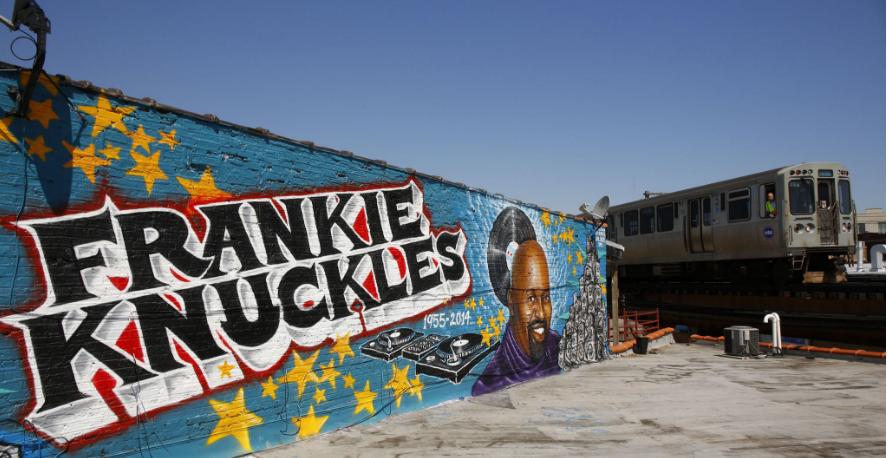
It seems far-fetched that a county that represents the city which gave birth to house music and has had both a street and day named after Frankie Knuckles and his legacy of house is failing to recognize the cultural and artistic value of not only electronic music, but other such diverse genres as rap, rock and country.

H/T: Chicago Reader

Nightlife Matters: A Call for Governments To Respect Our Scene As Part Of Local Culture

NightlifeMatters

Electronic music is an indelible part of the world’s nightlife scene. Our music represents the soundtrack and backbone of an industry that is alive in all four corners of the globe, and almost every country in between.

Yet, it is only in a select amount of countries that nightlife is truly respected as part of culture, as an expression of art and freedom. In the Netherlands and Germany, in particular, legislators, politicians and officials recognize nightlife and electronic music as a valuable piece of both the local and national economy. The appreciation for our industry goes a step further in cities like Amsterdam or Berlin, where those participating in nightlife are not only respected but celebrated as part of a movement that promotes tolerance, art and freedom.

Unfortunately, this isn’t the case in other countries. Australia, and in particular Sydney’s New South Wales state , has been facing uphill battles with local officials who have gone so far as to impose strict lockout laws effectively curbing the existence of nightlife in some of the country’s most populous cities. England is facing similar problems, in no small part due to gentrification and the significant change with which venues, nightclubs and bars interact with local neighborhoods and communities.

In the United Kingdom, the NTIA (Night Time Industries Association) has now launched a #NightlifeMatters campaign to increase awareness on the importance of our scene as part of local art and culture. The aim is to educate and change the viewpoints of the many on the other side of an irrational “us-versus-them” argument which constantly pits nightlife as unethical, quasi-criminal, uncultured and even dangerous.

Naturally, the campaign is backed by a great selection of high-profile artists the likes of Carl Cox, Eats Everything, Jackmaster, and Sasha, as well as venues and promotion companies. The always outspoken and active Seth Troxler has personally weighed in via Clash Music, underscoring just how important this message is for the longevity and prosperity of nightlife as we’ve all come to love it. The movement encourages everyone to sign their petition, and to tweet using the hashtag #nightlifematters to join and support this vital campaign.

“There are always multiple factors to consider when it comes to club closures. It’s hard to keep a business like that going for 10 years, just look at places like Plastic People or Dance Tunnel, even when a club is successful it’s hard work to keep it alive. But who’s responsible for these closures? Is it developers? Local councils? Licensing boards? Has club culture changed fundamentally, are kids today too boring? Or is it the government?


Of course it’s a combination of all those things but there’s one obvious way for us to change it. Vote.

We’re living in a time where the government likes to create media sensations around one topic or another. It’s not about them trying to save lives or change culture, it’s about who can keep themselves in the spotlight for the longest. Decisions are being made by people who are too old or too out of touch with what’s happening in the modern world. And it’s not just in the UK, it’s part of a global problem.

In places like Germany and Holland, local officials accept electronic music and nightlife as culturally valuable. They look at nightlife in the same way they do ballet. It’s not seen as something violent or criminal, it’s celebrated. They recognise that many of the people taking part in night culture are tolerant of different races, different genders and different sexualities. They recognise that nightlife has significant economic benefits, that it has the same capacity as high-art, fiction, food or film to inspire and influence a generation. In the UK and US, by contrast, there’s a total disconnect between night culture and ‘culture proper’. Legislators don’t understand who we are or what our value is, so there’s no desire to protect it.

If we’re to change these attitudes, we can’t just talk about them, we need to have more young people start participating. If we want to change perceptions about club culture we need to act. Part of the reason I launched Acid Future, part of the reason I’ve spent my life playing underground music, is to try and keep the dream alive, to try and fight the fight by educating people about electronic music.
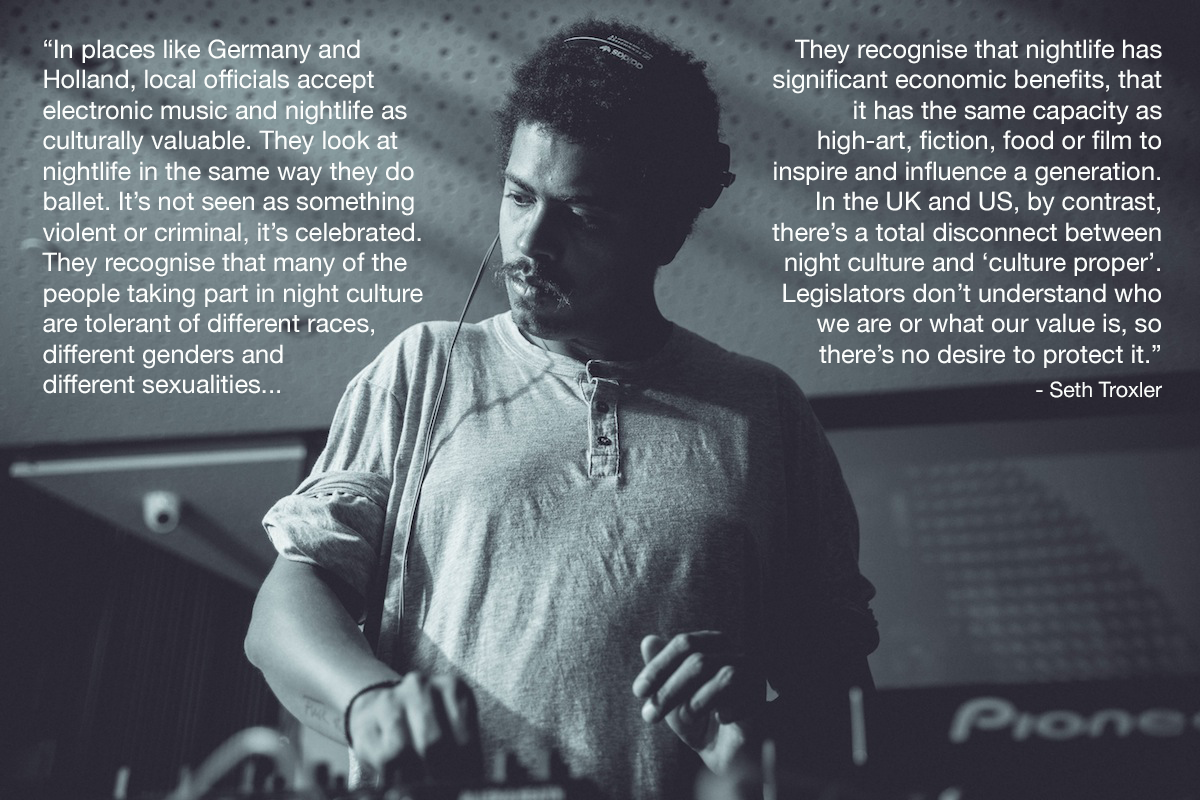
Seth Troxler Music Matters

#NIGHTLIFEMATTERS is addressing the same issues, albeit from a different angle. They’re going direct to policy makers, showing them who we are, showing them that we’re valuable, showing them that we aren’t the stereotype that they think we are or that we might have been in the 90s. Their giving young people a platform to make their voice heard, in just a few clicks on nightlifematters.com you can email local councillors and MPs to let them know why nightlife is important to you.

It’s a first step but it’s only the beginning. We’re at a point where the old structures of society are losing their grip, there’s a huge opportunity for young people to change both the government and its policies for the better. Take for example this guy Will Thompson, he used to work for our management company, he was incredibly brilliant, very cool. He quit so he could go back to school and start working in politics because he wanted to change the situation he found himself in. He realised that the only way to really change things is to get involved.

The only reason these conservative councillors get in is because the only people who vote in local elections are 65 year old tea ladies, if you had everyone in Shoreditch get involved in the political process you’d be able to protect bars and clubs in the area.

It’s not hard, all we need to do is participate. That’s how we’re going to protect our night life. That’s how we’re going to save club culture.”

Source: Clash Music

Moogfest 2016: Synthesis of Music, Art, and Technology

Screen Shot 2015-12-08 at 11.50.37 AMSince its inception in 2004, Moogfest has brought together the brilliant minds of entrepreneurs, philosophers, scientists, artists, musicians, engineers, and forward-thinkers for a weekend of progressive exchanges and inspirational demonstrations and presentations with regard to art, music, and technology. Read more

Burning Man 2016 Theme: Da Vinci’s Workshop

Manbase.AJ_

“Five centuries later, we will attempt to recreate this potent social alchemy by combining Burning Man art, maker culture and creative philanthropy to make Black Rock City the epicenter of a new renaissance.” – Larry Harvey and Stuart Mangrum

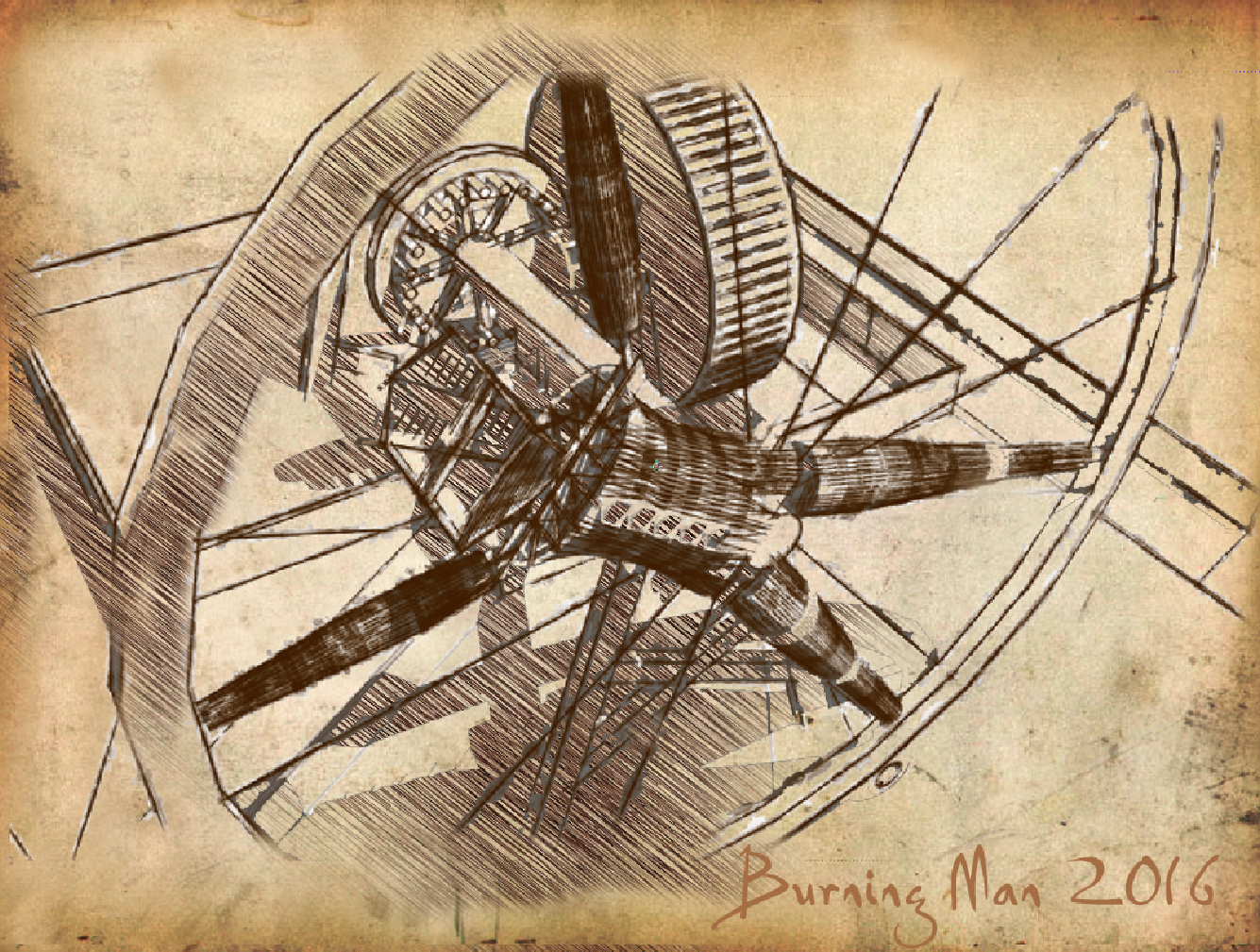
The Burning Man organization has announced the art theme for next year’s Burn, titled Da Vinci’s Workshop. The theme is of course inspired by the fundamental inventiveness and social ideas of artisanship of the Italian Renaissance during much of the fifteenth and sixteenth centuries. The Renaissance can be considered the quintessential art period that is taught in pretty much every art and art history class around the world, so it is proper for Burning Man to dive into the roots of Western art’s greatest movement. Read more