
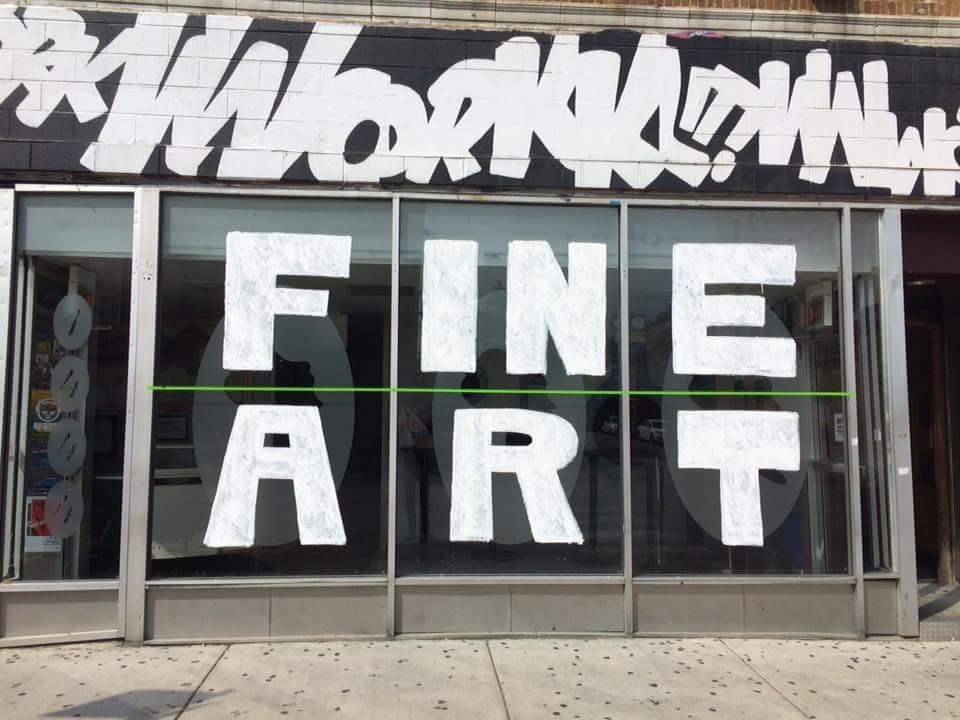
Beauty Bar’s current shop front, emblazoned with the words “Fine Art” in protest to the current court case pending with Cook County.
Last week Cook County made headlines when attempting to levy heavy back taxes, fines and impose future taxes on two small music venues in the City of Chicago by claiming that rock, pop, country and electronic music do not count as “music” or “culture.”
Despite an official hearing on the matter scheduled for October 17th, a Cook County board member took it upon himself to attempt to change the amusement tax ordinance in order to ensure that the two venues being targeted by the county – Beauty Bar and EvilOlive – are not forced to pay the combined $400,000 requested in the current court case.
Commissioner John Fritchey filed his amendment of the 19-year-old law yesterday, Tuesday August 30th. The original law states that venues with capacity exceeding 750 people must pay 3 percent of ticket prices for live performances of music, theater, sports and other entertainment. A Cook County official insisted in a preliminary hearing last week that “rap music, country music, and rock ‘n’ roll” do not fall under the purview of “fine art.” A change.org petition is currently doing the rounds urging the county to “vote Rap, Rock and DJ sets as Fine Art!”
Under Fritchey’s proposed changes, shows featuring DJs would be explicitly exempted from the tax. “I don’t believe that government should be playing culture police and deciding what constitutes ‘music,'” Fritchey stated. “Going after small businesses who have in good faith complied with what should be a common sense reading of the law is just plain wrong, and to have it happen in a city that has given the music industry some of its most famous DJs and rappers just adds insult to injury.”
Fritchey also sent a letter to Board President Toni Preckwinkle asking that the county revenue department stop attempts to collect back taxes from other businesses similar to the two being targeted by the council as long as they have complied with city policy.
Cook County spokesman Frank Shuftan spoke to the Chicago Tribune stating that officials had not yet reviewed the ordinance and could not immediately comment.
In an earlier interview with the Tribune earlier this week, Cook County chief financial officer Ivan Samstein stated that the county does not look into music genre as a barometer for which venues are exempt from the tax or not, but did specify that officials can and do differentiate between DJs playing original productions and DJs playing pre-recorded music in a DJ set.
“If a DJ is creating a new, original composition in the way they put sounds together, then that is also tax-exempt,” Samstein said.
Fritchey’s amendment of the contested law mirrors the aforementioned differentiation: DJ music would count as a live musical performance if the DJ was mixing their original work or used prerecorded music they compiled themselves. The amendment also states that the performer must be paid a fee that is “substantially higher” than someone who simply plays music recordings. Other exemptions exist under the proposed law change, including if the performer is featured in advertisements from the venue or if the DJ is being represented formally by a manager or agent.
H/T: Chicago Tribune


