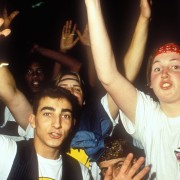
Let’s take a trip (no, not that kind of trip), but a trip back in time. To a time where raving and partying were a little more magical and a little more illegal (maybe that added to the magic). Go back to a time where whistles and glow sticks reigned supreme not fan clacking. Back to a time where people weren’t taking selfies for the ‘gram. It’s fascinating to see how much has changed throughout the years, but also how much remains the same in rave culture. So here we go, let’s begin the trip back to the past.
https://www.6amgroup.co/wp-content/uploads/2021/08/Love-Parade.jpg7201280Matt DraperMatt Draper2021-08-12 08:20:582021-08-11 12:07:39Rewind: Best Rave Videos from the Past
During the summers of 1987-89, Britain experienced one of its largest youth movements ever. A direct result of the rise of acid house, the introduction and consumption of ecstasy, and the need for a space where your looks, sexual orientation, or societal status didn’t matter. This social phenomenon is noted as the Second Summer of Love, referencing the sixties Summer of Love, where 100,000 hippies converged in San Francisco’s neighborhood, Haight-Ashbury, to experiment and become conscious of one’s existence.
At a time when rare groove and hip-hop dominated most of the UK club music scene, acid house was skyrocketing in popularity thanks to ecstasy and two of the most influential clubs in the UK, the Haçienda and Shoom.
https://www.6amgroup.co/wp-content/uploads/2017/03/seondsummeroflove-e1489541846248.jpg552997Lydia CastilloLydia Castillo2017-03-16 12:33:492019-06-20 07:52:12#TBT Series: The Second Summer of Love, Britain's Acid House Revolution
How much can a techno producer’s sound change in twenty long years?
Before you answer, you must consider that the first recorded use of the word techno in reference to a specific genre of music was in 1988. In less than thirty years since we have seen a myriad of sub-genres and styles come to life, launching the careers of new talented producers and DJs while also cementing the names of those early pioneers into the history books electronic music.
One such early influencer was Richie Hawtin. As part of the second wave of Detroit techno artists to emerge in the early 1990s, the Canadian producer became the leading exponent of minimal techno thanks to his work as Plastikman and as the head of the iconic Plus 8 label he began with John Acquaviva. In 1998, Hawtin launched M-nus Records and then in 2012 introduced the world to his ENTER. concept, an experimental event series that took Space Ibiza by storm and was then replicated at events throughout the world.
Although today Hawtin is a champion of technology, even curation and the evolution of live deejaying, it is always interesting to go back in time to investigate and navigate through the past and origins of the sound that launched his career in the mid-90s.
The below video immortalizes a Hawtin set performed at The End in London in 1996. We can tell you that the set includes tracks such as “Krackpot” by Plastikman, “Wisdom To The Wise” by Dave Clarke, “Filter King” by 69 (Carl Craig) and Vapourspace’s “Gravitational Arch Of 10,” just to name a few.
Has Hawtin’s sound changed? If so, how? Tell us on Facebook or send us a Tweet with your opinion!
https://www.6amgroup.co/wp-content/uploads/2016/10/Richie-Hawtin-90s.jpg352626Marco SgalbazziniMarco Sgalbazzini2016-10-06 06:27:132019-06-20 07:26:38#TBT Series: The Evolution of Richie Hawtin's Sound From 1996 to Today