Posts

MDMA comedowns

MDMA May Not Cause Comedowns, According to New Study

MDMA may not be the cause of your “Blue Mondays” after all, according to a new clinical trial.

The study, titled Debunking the myth of ‘Blue Mondays’: No evidence of affect drop after taking clinical MDMA, tracks the moods and reactions of 14 people who were enlisted into an MDMA-assisted psychotherapy course to treat an alcohol disorder. Read more

[PHOTOS] A History of the Second Wave of the Rave Scene

Guest Post from Michael Tullberg

I’ve been very fortunate to have been involved in the rave scene for as long as I have. Over the course of 25-plus years, I’ve been at some of the biggest and most important moments in rave history, starting in the warehouses of the mid-90s LA underground scene. Funny how some things don’t change that much over time. Back in those days, I ended up photographing and writing for most of the dance music magazines of the day. This enabled me to stick myself inside the core of American raving culture, which was right here in Southern California for nearly a decade. We were so incredibly spoiled during that time period since we had the best DJs in the world coming through here on a regular basis. There was no shortage of gigs for them to play at, whether the event was in a club, a mansion, a desert, on a beach, or a mountain. From the smallest after-hours to the biggest massives, we truly had it all here. Accordingly, most of the photos presented in this collection are from the L.A. area.

Read more

Mark Reeve Instagram

“Invest into a Culture, Don’t Buy a Party,” Says Mark Reeve on Instagram

Has music, specifically, house and techno lost its meaning? Techno artist Mark Reeve is cautioning against this in a recent Instagram post. You could say he had something to get off his chest and that he did. He comments on how music has become more about the bottom line than the art itself. “Hate me or love me but this is what I have been thinking for a long time now. Invest in a culture donā€˜t buy a party šŸ˜‰ā¤ļø peace” reads the caption of his post. Read more

Rewind: Best Rave Videos from the Past

Rewind: Best Rave Videos from the Past

Let’s take a trip (no, not that kind of trip), but a trip back in time. To a time where raving and partying were a little more magical and a little more illegalĀ  (maybe that added to the magic). Go back to a time where whistles and glow sticks reigned supreme not fan clacking. Back to a time where people weren’t taking selfies for the ‘gram.Ā  It’s fascinating to see how much has changed throughout the years, but also how much remains the same in rave culture. So here we go, let’s begin the trip back to the past.

Read more

Panic

30 Year Industry Vet & PANIC Founder Talks About Rave Culture & Its Future

30 and 25, those are the numbers PANIC founder LinusĀ has been DJing and producing respectively. In those years, he’s seen rave culture transform yet also hold onto its core principles. His event series called PANIC started in 2017 viewing it as a platform for greater inclusivity. Recognizing the male-dominated industry, Linus has sought to create an environment representative of rave culture welcoming all people both on the dance floor and behind the decks. A 30-year industry vet, Linus looks back on his inspirations while looking to those artists helping shape today’s scene.

Read more

Why The U.S.’ Zero-Tolerance Drug Policy Was Never Going To Work

Ā The Failing War on Drugs

During the 1960’s, ā€œHippiesā€ and celebrities popularized the use of marijuana, LSD, and other drugs. “During the Civil War, troops used morphine, uppers dominated World War II, the Vietnam troops shot heroin”, and their addictions didn’t stop there,Ā as the U.S.’ demand for drugs kept on growing.

The term ā€œWar on Drugsā€ was coined in the summer of 1971 after Ronald Reagan orderedĀ law-enforcement officials to directly target drug consumers rather than producers or suppliers.

Read more

Read: The DEA Defines Rave Culture

Rave Culture

The explosion of rave culture into the mainstream has naturally seen officials and government agencies interested in “understanding” and explaining the movement to one another as well as the general public.

The truth is, that rave culture is much more complex than anyĀ simplistic understanding coming from an outsider. Yet, it remains interesting to see just how such outsiders view rave scene and rave culture, especially at a time when campaigns are actively seeking to bring awareness to the benefits of our scene.

A recent FOIA request has unearthed a very interesting Drug Enforcement Agency document, a summary of ā€œThe Rave and Club Culture/Designer Drugsā€ available for public reading. Written in 2001, before the true advent of EDM as we know it, and its surge of popularity in the United States, the report is based off of inside intel from a retired detective who actively attended raves for nearly a decade between 1992 and 2001.

The full document, which you can read HERE, includes attempted definitions of a few genres of electronic music:
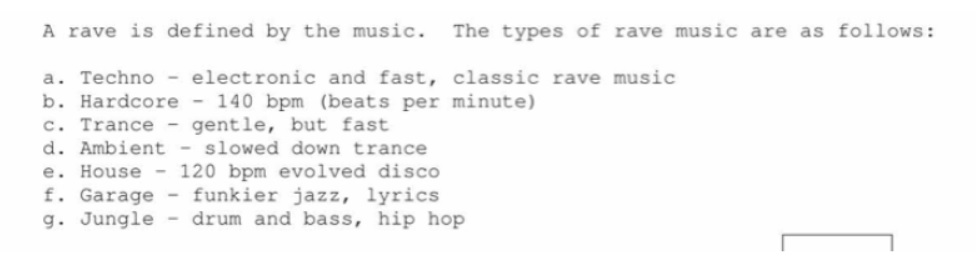
Rave Defined

It also dives into several aspects of rave culture including clothing, kandi bracelets and more:
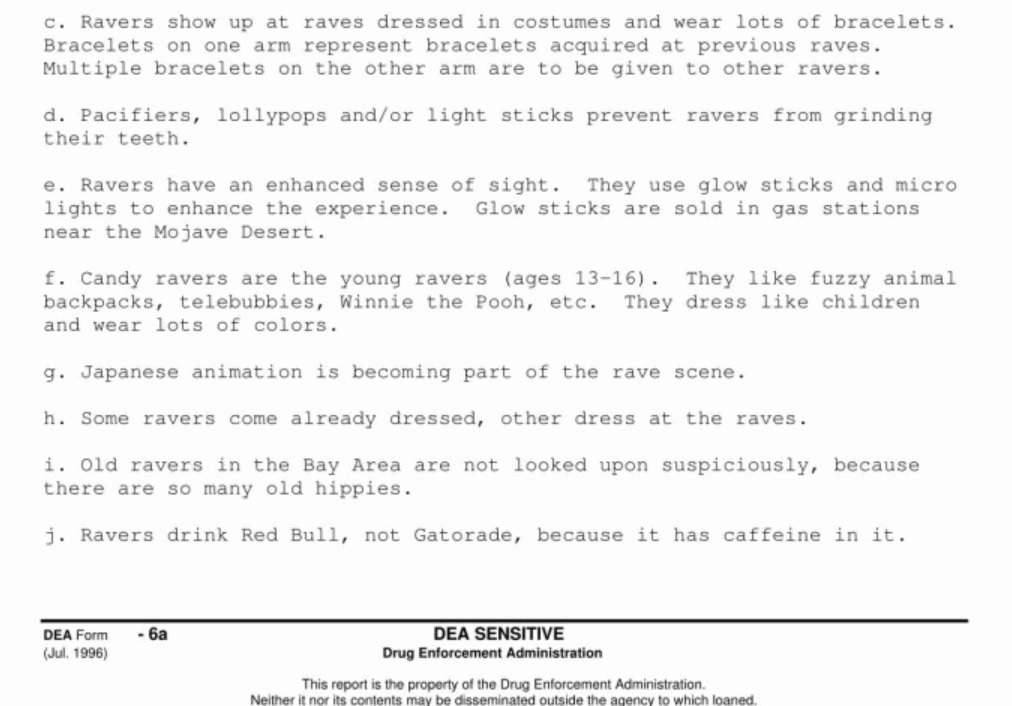
Rave costumes

Overall, there is no mistaking that whoever contributed to the writing of this information was fairly knowledgeable of rave culture, as this other excerpt proves:
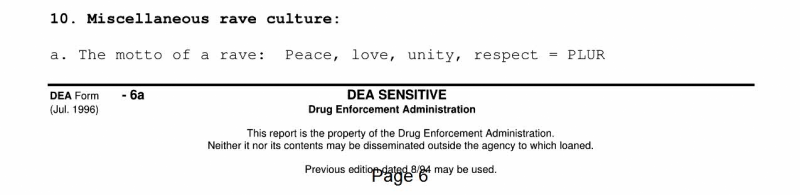
PLUR Rave


Source: Gawker