Posts

fabric Looking to Reopen With New Licensing Conditions

SaveFabric

Hopeful news coming out of London today: fabric is in advance talks with the local Islington Council and the Metropolitan Police to reopen in the near future.

The London venue had its license suspended and then ultimately revoked on September 6th following two drug-related deaths in summer and heavy pressure from local officials to shut its doors. The entire dance music community has since united to save what is considered to be one of the most iconic dance music nightclubs in the world, raising money to fund an official appeal that was originally scheduled to begin at Highbury Magistrates Court on November 28th.

The Islington Tribune has since reported that the appeal may not be necessary after all, stating that the club and police have been talking behind closed doors in an attempt to reach an out-of-court agreement on the matter that would allow the club to continue with business.

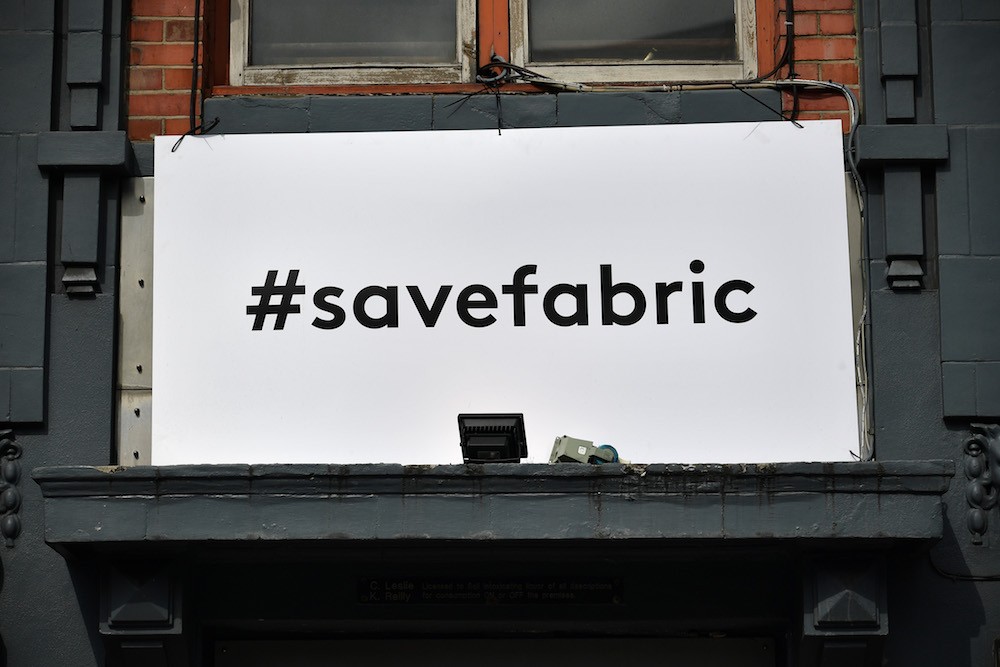
The move isn’t that surprising considering the overwhelming support received by fabric in their fight to stay in business. London’s own Mayor Sadiq Khan spoke against the closing of the club and has since appointed the city’s first Night Czar to work on developing London’s nightlife so that it’s protected and flourishing economically. Islington Council MP Emily Thornberry also stood by fabric’s side, as did the 160,000 who signed a petition to #savefabric and of course those who donated more than ÂŁ320,000 for the club’s #saveculture campaign.

H/T: Resident Advisor

Why Are So Many Nightclubs in Europe Closing Down?

XOYO

It appears that European nightclubs are not benefiting from the very same rebirth and surge in popularity that we are witnessing with electronic music as a whole industry.

Based on data collected from Resident Advisor, the Economist published a study that dives into the decline in numbers of nightlife venues throughout Europe.

The accompanying map of Europe below tells a specific tale, one of a clubbing industry in the wane. Red dots delineate the European nightclubs that are listed as closed down in 2016 by Resident Advisor. The principal cause, you may have guessed, is gentrification. The term specifically refers to the transformation of an urban area caused by the purchase and renovation of houses by upper or middle-income families or individuals. While of course property value increases, this often results in displaced low-income families as well as the closure of small businesses and, as we are now seeing, businesses that cater to a lifestyle in contrast with that of the neighborhood’s new occupants.
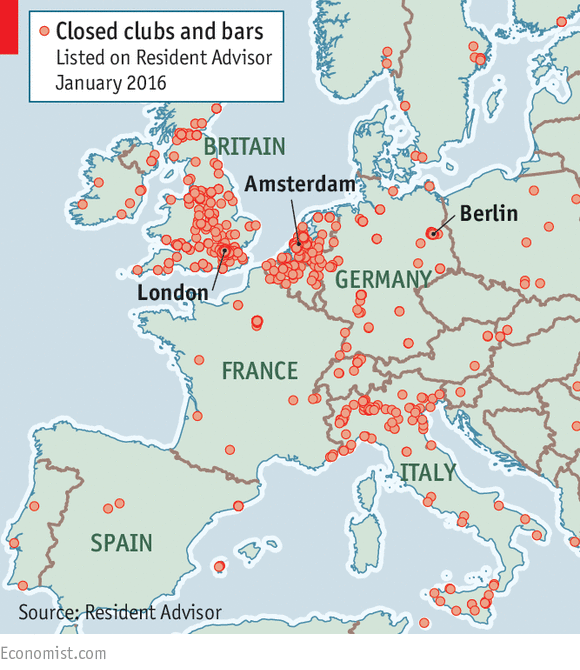
Closing Down MapThe Economist lays out some key figures:

  • Between 2001 and 2011 the numbers of so called discotheken in the Netherlands fell by 38%.
  • In Britain there were 3,144 clubs in 2005 but only 1.733 ten years later (Source: Association of Licensed Multiple Retailers).
  • Again in Britain, in 2015 revenue were ÂŁ1.2 billion ($1.7 billion), down from ÂŁ1.5 billion in 2010.
  • In Berlin the number of music venues remains stable at 350 (120 clubs), although several long-established night spots have closed down.

Increased rent prices, lack of available venue space and the muffling effect of gentrification has hit the nightlife industry hard. This is no more evident than in London and, specifically, with the high-media case surrounding the revocation of fabric’s license. It takes one neighbor to complain for others to join suit, beginning a sort of power-war that sees local councils often swayed to keep “many voices” happy rather than to protect the late-night establishments in the area.

“If there’s one complaint, then the whole circus starts,” said Eelko Anceaux of De Marktkantine, one of the handful of clubs that bucked the trend and opened in Amsterdam in 2014. It is possible to build good relations with neighbors, he claims, also buying on a business strategy that sees his club double as a restaurant, thus adding a more acceptable value proposition to the eyes of families and middle-class residents. Yet, complaints about noise and drunk or stoned club-goers are hard to avoid, rendering the life of any club owner tricky to deal with.

Again, it must be understood that it’s these complaints that put local officials and politicians smack in between a rock and a hard place. We agree, of course, that the solution is never to shut down a night club just to second the whim of local yuppies who look down on the nightlife industry as a disease. The truth remains, however, that politicians get stricter about licenses, code violations, and complaints, often leading to accusations by venue owners and patrons of officials purposely targeting nightclubs as a result of pressure from commercial or residential neighbors. We have seen this happen to fabric prior to the recent closure, when the club won a year-long court battle against Islington Council, which wanted to introduce drug-sniffing dogs among other strict security measures. We have been seeing this happen with Ibiza clubs, who are being targeted with early sound curfews, fines, temporary closure for code violations or complete party shut-downs. We have seen this happen with the closure of u60311 in Frankfurt, and that of two Berlin clubs in 2015 for fire code violations. And there are plenty more such examples.

There is no point in denying the inevitable: despite the action by some cities to prevent the decline from continuing further, we are likely to keep seeing this trend in the near future. Amsterdam has had a Night Mayor since 2002, a position that lobbies on behalf of night-time club and entertainment venue owners. Recently the City of London announced that it is recruiting for the position of Night Czar, charged with transforming the city into a true 24-hour destination. In Germany, Mr. Lutz Leichsenring of the Club Commission sits on a working group for the Berlin chamber of commerce, while Berghain/Panorama Bar was recently bestowed the honor of being recognized as a “high-culture venue“. The idea is for these night-time positions to increase and improve relations between governments, neighborhoods and of course clubs and other type of late-night music venues.

Despite the above, there are other factors responsible for the slump of the nightlife industry in Europe: the decline of 24-hour party people. There are social changes that are in themselves changing the way the current youth generation thinks and behaves. Firstly, the European Monitoring Centre for Drugs and and Drug Addictions is reporting a marked decline in MDMA consumption with 15-34 year olds in Germany, Britain, Denmark and Spain. While trends in the use of other drugs less closely linked to clubbing, such as cannabis and cocaine, vary by country, the statistics relating to ecstasy indicate that the European youth of today may surprisingly me more abstemious than that of 10-20 years ago. This idea is further strengthened by statistics that point to a fall of heavy alcohol consumption among young people. In Britain alone, between 2005 and 2013 the proportion of 16-24-year-olds who were frequent drinkers (defined as drinking alcohol on five days in the previous week) fell from 7% to 2%. The price of drinking has also increased, which, coupled with 2008’s economic crisis and resultant years of austerity, is having a say on how much young people leave their house to party at nightclubs.

Drug Closing Down GraphThe second factor to impact on club prosperity is the surge in popularity of music festivals. In 2014 around 130 festivals took place in Amsterdam alone, while in Britain around 250 take place annually, up from 80 in 2004. Croatia is another country that has seen tens of festivals spring up out of nowhere in the last 5-8 years. Dance music fans are finding themselves saving up to attend these big-scale expensive weekend affairs, thus choosing not to visit nightclubs at home. Further, festivals can often drive up the price of booking big-name talent, making it hard for competing local venues to feature them on their weekend lineups.

This year the global nightlife scene has woken up to the aforementioned changes, launching initiatives to combat the problems causing this downward trend. The Opening Debate at this year’s Amsterdam Dance Event will featuring some of the brightest, highly passionate and most dedicated people the dance music industry has to offer giving their hotly sought opinions on important topics including the direction of nightlife in the UK and Europe in general.

While the movers and shakers in the scene keep working to ensure that nightlife remains protected, we encourage every single dance music fan in the world to support their local scene, venues, promoters, artists and record stores. Only united can we truly show local governments and communities that nightlife does matter.

Not All Heroes Wear Capes: Man Danced 24 Hours to Raise Funds for fabric London

Fabric Griffith

When you love something, you will go to any length to protect it.

That was exactly the case for a London fabric fan by the name of Tim Griffith, who decided to dance for 24 hours straight outside of the closed club in an attempt to raise £2,000 for its legal battle to re-open.

Griffith’s gofundme page clearly explains how music is his number one passion, a love that translates to a job as an audiovisual technician and a DJ/music production career which he continues in his spare time.  When talking about his planned exploit, Griffith explained, “A few weeks back I made the decision to organise a 24 hour, non-stop dance outside the doors of fabric, in order to raise money to contribute towards fabric’s legal fees, which the club needs to raise in order to appeal the revocation of their licence.”

#savefabric

A video posted by Charlie Hunter (@chas00000) on


The Islington club has officially appeared against the local council’s decision to revoke its license, with a formal court date set for Monday, November 28th. Dance music fans all over the world are raising funds online to assist with the legal fees and to ensure that the club staff are able to survive through this period. Thus far a total of £282,918 has been raised, with a series of dedicated benefit nights featuring top-tier acts such as Ricardo Villalobos, Nina Kraviz and Seth Troxler all scheduled for October and December. Griffith began the 24 hour dance marathon at noon GMT of Friday and terminated it successfully today.


Fight With fabric: Join the Fundraising Campaign to Save the Club

Fabric Campaign

London’s fabric is acting on their promise to fight to re-open the venue, launching an official campaign to raise money for its appeal against Islington Council’s decision to revoke their license.

Read more

Remembering fabric: 10 of Our Favorite Live Set Recordings from fabric London

Sasha playing Room 1 at fabric in on the 21st of June 2003

Sasha playing Room 1 at fabric in on the 21st of June 2003

Less than 24 hours after the dance music community learned of fabric London’s forced closure, I choose to begin remembering the greatness of the iconic London venue through what it did best: its music.

Read more

Breaking News: fabric’s London’s License Has Been Revoked, Club to Close Permanently

fabric

It is with a heavy heart that we just learned of the final outcome of today’s review on whether fabric London would be allowed to re-open following a temporary closure by the local Islington Council. The closure was ignoted by the death of two 19-year-old men over the space of 9 months.

The last month has been tumultuous for the club to say the least. It first shut down for a weekend to investigate the two deaths and was later at the receiving hand of a temporary and indefinite license suspension as the local council and the Met Police arranged for a final and full review of the venue’s license to occur today, September 6th 2016. The debate has been heated in the weeks leading up to today’s meeting at Islington Town Hall, sparked by heavy passion on both sides, with dance music fans around the world and leading members of the international dance music scene lending their voice in support both via a change.org petition as well as through personal and social network communication channels.

Editors of Mixmag were able to attend the meeting today, and just reported that unfortunately “after over six hours of debate and review, the committee decided that ‘searches were inadequate and in breach of the license’. Fabric’s license will be revoked and the club will be forced to close permanently.” According to the report, the ultimate decision was made by the licensing sub-committee. “There is a culture of drugs at fabric which management cannot control,” Licensing sub-committee Chair Flora Williamson stated in a closing statement reported by Mixmag.

The Chair of the Nightlife Industries Association, Alan Miller, stated that the organization will begin a Fund For Fabric to fight the decision with the hope to have it revoked.

Music Monday: Listen to the 12hr fabric Takeover of Rinse FM ft. Ricardo Villalobos, Marcel Dettmann, Nina Kraviz & More

Rinse

Start your week proper with an entire 12 hours of top-tier underground house and techno from some of the biggest names in the international touring circuit.

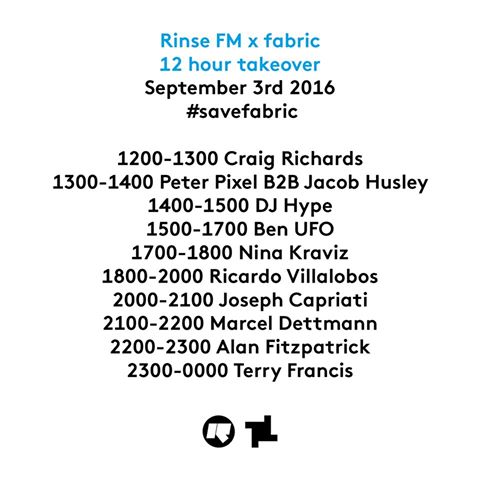
This past Saturday, 3rd of September, fabric London took over Rinse FM for 12 hours as part of the current #savefabric initiative to save the club from closure. The venue is facing an official review of its license by the local Islington Council and Metropolitan Police as a result of two overdose deaths that prompted local officials to close the club indefinitely pending the aforementioned incoming review. Recently, London’s Mayor Sadiq Khan has weighed in with an official statement replying to the #savefabric petition that has been doing the rounds to urge him to intervene in ensuring the club isn’t permanently shut down.

Read more

Mayor of London Sadiq Khan Responded to the #savefabric Petition

Sadiq Khan, Mayor of London

Sadiq Khan, Mayor of London

Sadiq Khan, London’s recently appointed Mayor, has responded to the petition to save fabric following the club’s recent temporary license suspension.

Released on change.org today, the statement comes on the heels of his August 17th tweet, in which Khan pressed on the Met Police and Islington Council “to find an approach that protects clubbers’ safety and the future of the club.”

Following the over 90,000 signatures on the petition, Khan’s latest statement is far lengthier but once again stresses his commitment to appoint a Night Czar for the city all the while pressing officials involved to save fabric’s present situation by finding a “common sense solution.”

The full statement reads:

Thank you for writing to me about the future of Fabric and London’s night time economy.

London’s iconic clubs are an essential part of our cultural landscape. As Mayor, I’m determined to do more to protect them, as well as our theatres, live music venues, artists workspaces, historic buildings and pubs. It is so important that people are able to enjoy a fun and safe night out in the capital.

As part of our wider plan to support the night time economy, I will appoint a Night Czar to lead this work by bringing together key stakeholders including club and venue owners, planning and licensing authorities, the Metropolitan Police and members of the public. No single organisation or public body can solve these problems alone – we all need to work together to ensure London thrives as a 24-hour city, in a way that is safe and enjoyable for everyone.

I am committed to using the influence of my office to overcome the numerous challenges facing the night time economy. However, it is important to note that City Hall does not have the power to intervene in licensing cases like the current situation with Fabric.

Clubbing needs to be safe. There have been two tragic deaths at Fabric over recent months and there are clearly issues that need addressing.

http://www.islingtongazette.co.uk/news/fabric_drug_deaths_damning_dossier_reveals_scale_of_substance_abuse_inside_farringdon_superclub_1_4674138

Fabric, the Metropolitan Police and Islington will of course have to take real action to protect the safety of everyone who enjoys a night out at the club.

My team have spoken to all involved in the current situation and I am urging them to find a common sense solution that ensures the club remains open while protecting the safety of those who want to enjoy London’s clubbing scene.

I welcome your call for us all to work together – City Hall, London’s music venues, local authorities, the police and others – to make our clubs safer while also protecting our night time economy.

Best wishes,

Sadiq Khan
Mayor of London

Sign the petition here.

Make Your Voice Heard and #savefabric From Closure!

Save Fabric banner

fabric is facing an upcoming license review on September 6th that could potentially close the venue for good.  The club is now asking its patrons and music fans from all over the world to join the #savefabric campaign by signing a petition to keep the club open.

The London nightlife institution could be closing down for good after its license was suspended by the local council in liaison with the Metropolitan police following the recent death of two clubbers from drug overdoses. The situation has sparked international attention, with artists, record labels and other venues lending their voice to save the club and asking the Mayor of London Sadiq Khan to step in to assist.

Mr. Khan has called for a solution that both saves the venue and safeguards patrons, going a step further by launching a hiring campaign for the first ever Night Czar in London that will be charged with shaping London’s future as a 24-hour city.

Islington Council will hold a scheduled review of the club’s license on September 6th, where both councillors and authorities will forward their arguments and push for one of three solutions: a change of license, a suspension of license or even closure.

In an effort to ensure that the club does not shut down, the venue is encouraging supporters to sign a  Change.org petition to underline the club’s importance.

You can sign the petition here.

The club released the below full statement on the current situation via its Facebook page:

Think You Have What It Takes to be Night Czar of London?

Ministry of Sound in London

Ministry of Sound in London

Following on his promise to focus on and highlight his city’s nightlife, the Mayor of London is looking to appoint the UK’s first Night Czar to shape London’s future as a 24-hour city. This comes on the heels of the recent controversy with fabric London, which remained closed at the orders of the Metropolitan Police and Islington Council following two recent drug overdose deaths. Sadiq Khan, London’s Mayor, stepped in encouraging officials involved to get to the root to the problem without keeping the venue closed.

Now, the Mayor has launched a search for the UK’s first Night Czar, a new position that will be charged with championing the value of London’s night time culture whilst developing and diversifying London’s night time economy.

The official job insert specifies that the following duties will be required of this new position:

“Working with the Mayor, the Night Time Commission, local authorities, businesses, the Metropolitan Police Service, Transport For London and other agencies, the Night Czar will create a vision for London as 24-hour city and a roadmap showing how the vision will be realised. The Night Czar will have proven leadership ability, public profile and convening power, plus a thorough understanding of the night time economy and the ability to work in a political environment.

This is initially a one-year officeholder post with a time commitment of up to 2.5 days per week.

London’s diversity is its biggest asset and we strive to reflect London’s diversity in all GLA appointments. We welcome applications from everyone regardless of age, gender, ethnicity, sexual orientation, faith or disability.”

You can apply for the position, which pays £35,000, until Monday 12 September at 23:59 GMT. Interviews will take place at: City Hall on Wednesday 21 September 2016.