Posts

tasha blank

“Nobody Doesn’t Have Rhythm” – Tasha Blank’s Drive for Dance

Tasha Blank is a celebrated international DJ, motivational speaker, and founder of BODY LVNGUAGE (formerly The Get Down), a global dance party reviving the soul of nightlife. With its uniquely raucous, sexy presence and rich culture of respect, all bodies are welcome.

Tasha is also the driving force behind Powerhouse DJ School: a leadership academy building a new breed of DJ. Rather than simply focusing on the technical aspects of the craft, PhDJ teaches artistry, creative discipline, ritual, the body-mind connection, event production, and everything else emerging DJs need to ignite the kind of dance culture we didn’t know we needed.
Read more

short film berlin

‘Beyond Sound’ Shares Early Moments of Berlin’s Club Culture

Watch a short film about Berlin’s party scene in the ’90s and ’00s. Directed by filmmaker and DJ Leonie Gerner (AKA Moogli), Beyond Sound charts the evolution of the city’s world-famous scene through the story of two veteran DJs: Heimlich KnĂŒller and Madmotormiquel.

Read more

First Warehouse Party

No Flash: Should Phones be Banned from the Dancefloor?

Dancing in the club is usually a night to escape and get away from the mundane of daily life. Often times being in the middle of a crowded dancefloor can wash away any pain, anxieties or stress that life has caused us that day or week. Having your body blend into the others around you, blending with a sea of people rather than just yourself can often be freeing and healing for some. But one thing that has taken away some of that freedom in recent years has been the advent of the smartphone and social media. So, should phones be banned on the dancefloor?

Read more

DJs stage presence

To Dance or Not to Dance: DJs & Their Stage Presence

When you go to a show, do you care what the DJ does onstage while performing? If a DJ doesn’t pump up the crowd, are they really doing their job? It’s an age-old question in the dance music scene and one that recently re-sparked a lively discussion thanks to social media. Dance music fans are split: what makes a good DJ, a good DJ? Is it just the music and technical skills alone? Do artists who put work into their live production also deserve accolades? Do DJs need an onstage persona or gimmick? Should they even be up there enjoying themselves or focused solely on curating the perfect set?

Read more

Raving During COVID-19

Raving During COVID-19: Are DJs Compromising Club and DIY Culture?

Let’s talk about the elephant in the room: raving during COVID-19. At the start of COVID-19 the dance music community came together and found alternate solutions to live music events. Necessity is the mother of invention and many quickly became tech experts. From DJs to promoters, they flooded the virtual gates hosting live streams through various channels. However, after almost six months since lockdown first started, it seems as if many have had enough of these pseudo-get-togethers, including some big-name DJs.

Read more

Berlin Officials Pledge $1M+ To Save Club Culture

Berlin has long been known as one of the world’s centers of club culture and the creative arts. Some estimate that about 50 percent of the 32 million tourists who visited the city last year came because of its vibrant nightlife scene and the “open spirit of the city,” which in turn generates billions in revenue.

But despite Berlin’s stature and the benefits it has been reaping from this stature, the city has been dealing with many challenges similar to what clubs around the globe are facing. The statistics tell a clear story: about 170 clubs have closed in the city since 2011.

Read more

Opinion: The Dehumanization of Electronic Music and Why DJs Must Learn to Accept Criticism From Fans

Over the weekend the words posted on social media accounts by Canadian artist Tiga had a lot of people talking.

In a post that appeared on his Facebook, Twitter and Instagram, Tiga opened up and discussed a subject rarely tackled in the world of electronic music: it’s simply impossible for a DJ to have a perfect set every single time. Peers and music fans alike weighed in, and how could they not after reading such a singular perspective from an artist as recognized as him.

Ultimately, Tiga shined a light on a side of electronic music culture that is sometimes easy to lose track of but that remains essential for the true artistry of the genre we love to flourish and prosper: the human element.

Read more

Read: The DEA Defines Rave Culture

Rave Culture

The explosion of rave culture into the mainstream has naturally seen officials and government agencies interested in “understanding” and explaining the movement to one another as well as the general public.

The truth is, that rave culture is much more complex than any simplistic understanding coming from an outsider. Yet, it remains interesting to see just how such outsiders view rave scene and rave culture, especially at a time when campaigns are actively seeking to bring awareness to the benefits of our scene.

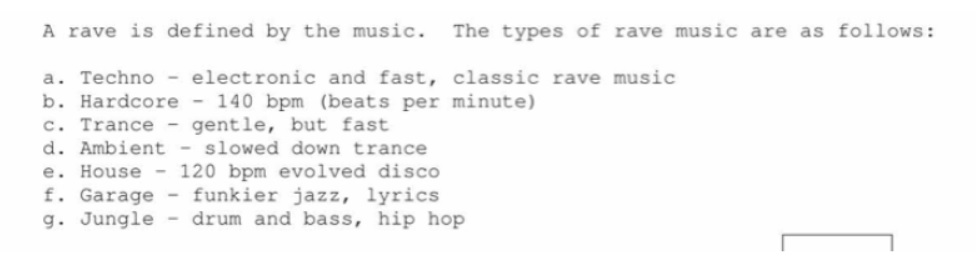
A recent FOIA request has unearthed a very interesting Drug Enforcement Agency document, a summary of “The Rave and Club Culture/Designer Drugs” available for public reading. Written in 2001, before the true advent of EDM as we know it, and its surge of popularity in the United States, the report is based off of inside intel from a retired detective who actively attended raves for nearly a decade between 1992 and 2001.

The full document, which you can read HERE, includes attempted definitions of a few genres of electronic music:

Rave Defined

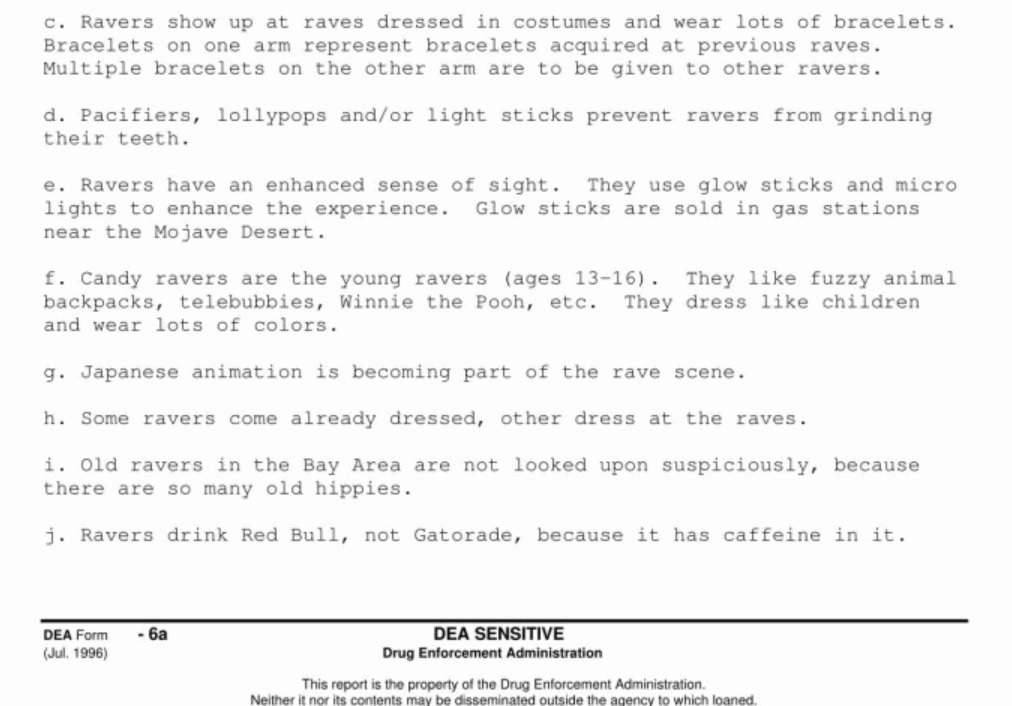
It also dives into several aspects of rave culture including clothing, kandi bracelets and more:

Rave costumes

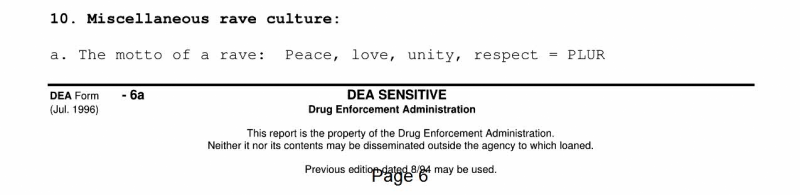
Overall, there is no mistaking that whoever contributed to the writing of this information was fairly knowledgeable of rave culture, as this other excerpt proves:

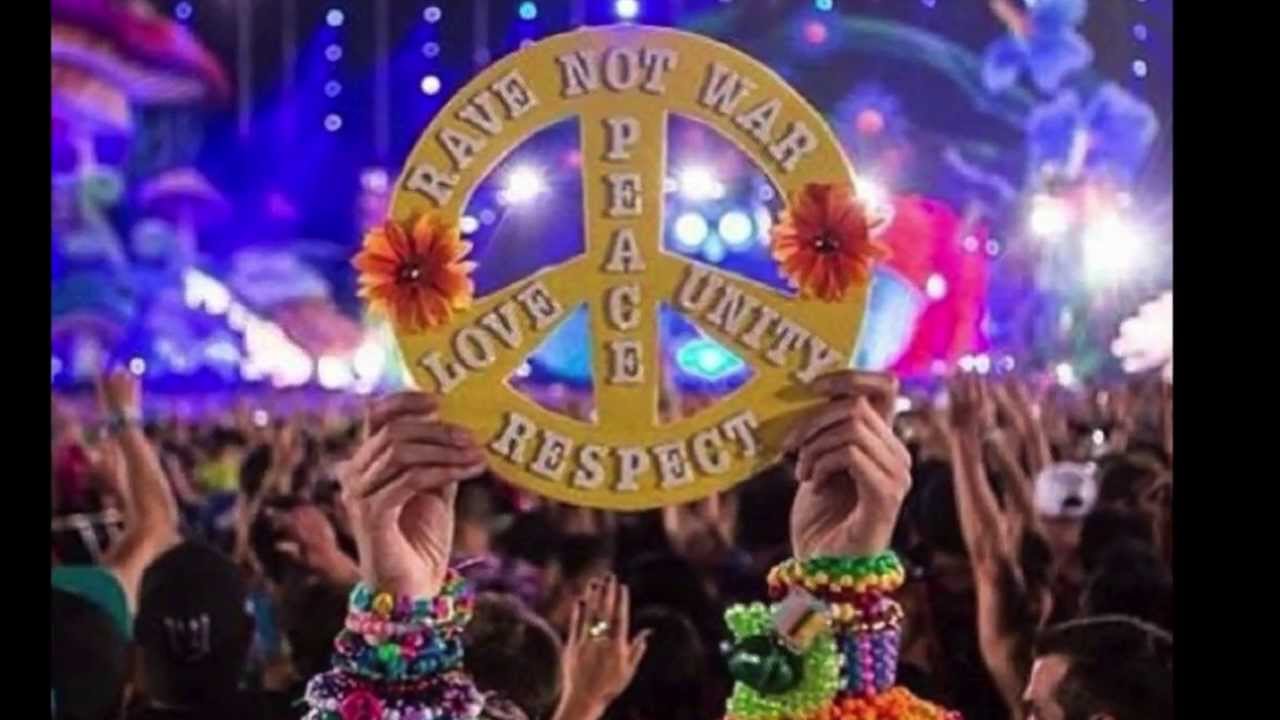
PLUR Rave


Source: Gawker