
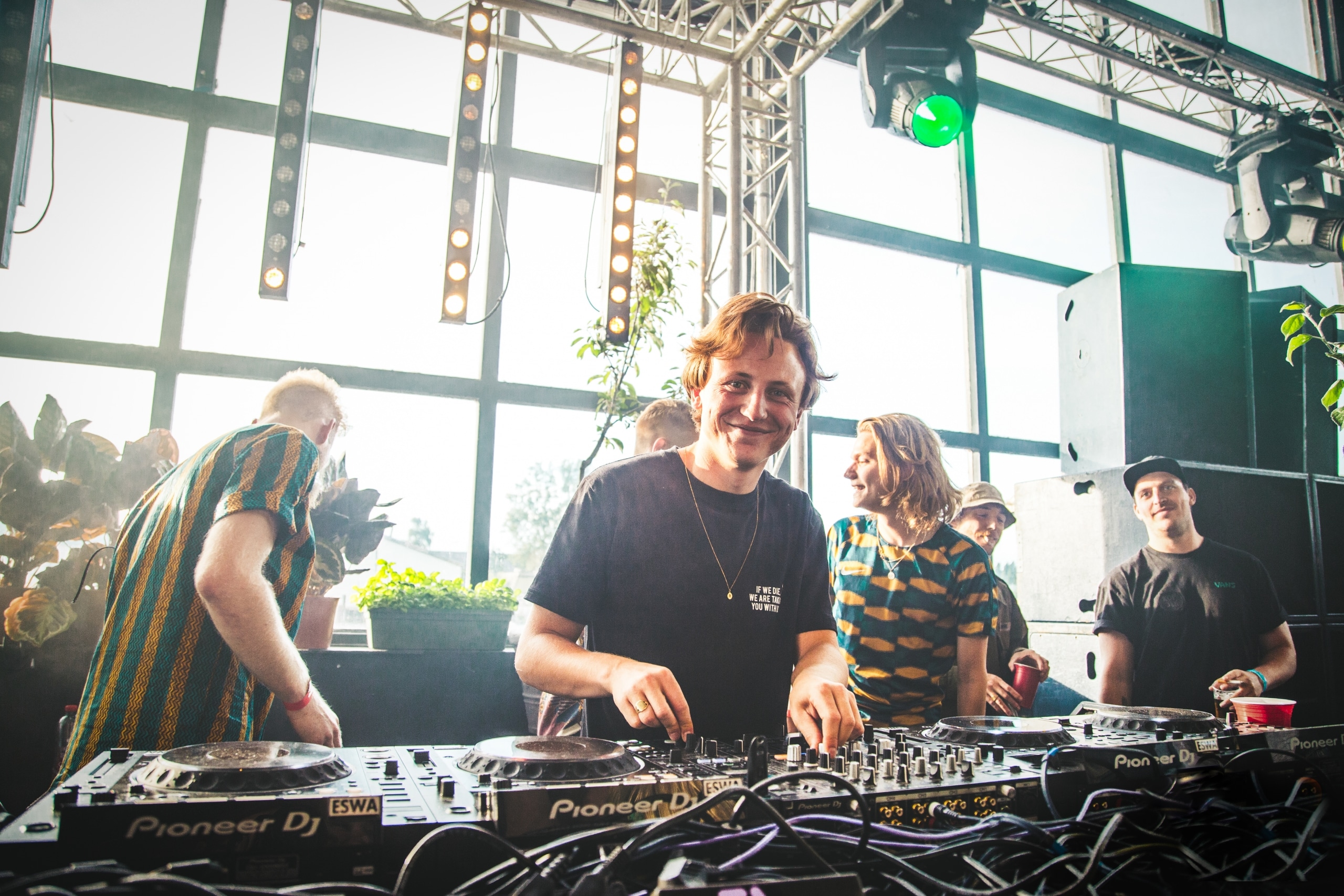
6AM recently caught up with Tjade to discuss his recent EP Balancing Act as well as a few of his inspirations and how the past year spent in lockdown has affected his workflow and production.
Tjade is one of the more promising young talents coming out of the Netherlands in recent years. He has regularly graced established labels such as Live at Robert Johnson, Mule Musiq and many more. Additionally, his productions have been picked up by several of electronic music’s most esteemed. Most notably would be 2019’s “Koi Jaye” shot him into global recognition thanks to plays at DGTL, Dekmantel and AVA by the likes of Palms Trax, Job Jobse and Hunee to name a few.
Hi Tjade and thanks for talking to us today. For our readers who aren’t familiar, can you tell us a bit about yourself?
Hello! Thanks for having me! My name is Tjade and I grew up in the Northern regions of The Netherlands. I studied in the city of Groningen, where I quickly found myself drawn to its very vibrant nightlife. It was in this city that I joined the renowned party crew KopjeK, who taught me everything there is to know about events and being a DJ. Over the course of seven years, I had the chance to learn all the ropes and practice it in all the great venues the city has to offer.
During my last years in the city, I slowly started to get chances to play elsewhere and also got into making music myself. My first release on Bordello a Parigi was around the time I left Groningen to go live in Utrecht. It was time for the next chapter and also for a new city. Utrecht is now a nice and centrally located home base for me to go out and play across the country (and sometimes beyond).
I was struggling with some personal situations and issues and it was all just a bit too much for me. I needed to let it all out, but couldn’t do that in a DJ booth anymore, so I put it all into this EP.
Tjade on how the pandemic affected his work
Your release “Balancing Act” is out now on Andre Hommen’s These Eyes label. How did the release come about and can you tell us more about it?
Andre and I started talking after my debut EP on Mule Musiq. Kompakt distributed that EP as well and Andre was really into it, so he asked me if I had more music. This was already at the early stages of lockdown, so I had plenty of new tracks finished by then, including this EP.
The Balancing Act EP is made out of frustration, anger, and sadness. I just started touring internationally after working on my career for almost ten years and could finally drop all other side-jobs when the pandemic hit. On top of that I was struggling with some personal situations and issues and it was all just a bit too much for me. I needed to let it all out, but couldn’t do that in a DJ booth anymore, so I put it all into this EP.
“Balancing Act” is a musical metaphor for my state of mind at the time, which was constantly balancing on this line and sometimes tipping over. You can probably hear which side is which. “Means to an End” was made a little later, when I accepted the powerlessness I had in this whole situation and felt that I should just strap in for the ride.
The personal nature of both tracks and the fact that I didn’t think of the dancefloor while making them made me think that no one would ever release it. Andre fell in love with them instantly though and he’s been amazing to work with during the whole process. He’s super involved and also very carefully listened to my wishes. I hold him in very high regard.
Many producers spent lockdown buried in the studio making lots of new music. Is this something that you did too? If so, how did you find it and did it affect you creatively?
At first, I thought; this isn’t all that bad. I just started touring intensively for the first time and felt that it sometimes came at the expense of studio time. So when gigs were out of the equation I had all my time free to make new music. The first six months of lockdown I approached it like an office job. I spent 9-5 in the studio and then shut everything down to go cook and have the evening off. I was super inspired and productive.
After six months though the walls started closing in on me and my inspiration was gone. I noticed that I needed to be on dance floors and in crowds in order to come up with new ideas. I am someone who makes music from emotion and I can’t fake that, so I accepted the fact that this was it for me and I haven’t really made much ever since. I did finish a couple of EP’s and remixes during the first period though, so I felt like it was okay for me to also not make music for a while.
Can you tell us a bit about your studio setup?
It’s super boring, to be honest. I learned how to produce when I had very little financial means, so that meant that I couldn’t buy any hardware. I got a small selection of plugins and drum samples and forced myself to completely figure those out before getting new ones. I now know a handful of them inside out and I can make almost any sound I like with them. So my studio consists of two monitors, my laptop and a midi-keyboard. I do have the Novation Bass Station 2 though, which is a nice mono-synth, but I don’t use that very often. When I was younger I always thought I would end up buying lots of drum computers and synthesizers, but now I’m not so sure anymore.
[Berliners] just immerse themselves completely in the night and surrender themselves to the DJ. This is the kind of connection between DJ and crowd that I’m looking for and prefer. I am there to give you the best of times and I love it when you let me.
Tjade talking about the DJ/crowd connection
You grew up listening to the likes of Tiësto, Armin van Buuren and Don Diablo. How did this shape you musically?
Tiesto and Armin were my heroes when I was about 10 years old. I loved everything about the music they made and the DJ life they were living. Don Diablo came after that, probably when I had my first computer and went on the internet to dive into new music. The music Don Diablo made sounded so futuristic to me and I think his 2faced album was on repeat for the most of my teens. I loved how he brought electro and pop together.
It was Tiesto and Armin who influenced me the most sound wise though. I fell in love with trance synths as a small kid and that love has never left. I think there are trance elements in every track I’ve made and I also find myself looking for that element whenever I search for new music to play. There is something about the emotion in that sound that just resonates with me very deeply. It’s also very bombastic and I am a bit of a showman, so there is also that.
You are now based in Utrecht in The Netherlands. Can you tell us more about the city and what it has to offer? What is the music scene like there?
To be honest it was quite hard to move from Groningen to Utrecht music wise. Underground culture is deeply embedded within Groningen and it was also the only city in The Netherlands to have no closing times of bars and clubs for a very long time. This created the perfect conditions for underground dance to evolve. Utrecht at this point doesn’t offer much on the electronic front. There is a lot to enjoy on the pop and rock front, but not that much else. There are some venues and collectives doing the best they can, but with Amsterdam, Rotterdam and The Hague right around the corner the competition is very high.
At this moment I think WAS is the most promising project in the city, which is run by the people behind Soenda Festival (amongst other things). Also EKKO and Tivoli have some great nights in their program, but both also focus on many other styles. If I wasn’t a DJ and producer I would probably spent my time here trying to create something new. The city could do with a good small to medium sized club with a challenging electronic program that is open two or three nights a week.
If you could play in any city in the world where would it be and why?
It’s going to sound a bit cliché, but every time I played in Berlin I absolutely loved it. The dancefloor to me is sacred, and the people in Berlin understand that very well. They just immerse themselves completely in the night and surrender themselves to the DJ. This is the kind of connection between DJ and crowd that I’m looking for and prefer; I am there to give you the best of times and I love it when you let me.
Other than that I also adore Barcelona and its electronic scene. A very long outdoor set in the burning sun somewhere in the city is something I dream of.
When it comes to djing and producing, which do you prefer?
DJing most definitely. I am an entertainer and I feel most comfortable in a DJ booth. I love electronic music and I love to be able to give people a good time. If those two things come together whenever I play I am at my best. Producing is a way for me to express emotions and feelings I can’t or won’t put into words. Its almost therapeutic at times, but I don’t enjoy it as much as standing in front of a crowd that’s really into what I’m doing.
Who are your favorite DJs and producers at the moment and why?
My favorite DJ of all time is by far Job Jobse. The way he reads a crowd and always puts their needs first is an art form. You will rarely catch him staring down at his CDJ’s or mixer for a long period of time; he is always analyzing what happens in front of him and looking to make that connection with his audience. In a time that almost every big DJ is also a big producer, it is really refreshing to see that the DJ DJ didn’t die off yet.
Producer wise I would have to say David Jackson, Moving Still, Kendal, Senor Chugger and Marlon Hoffstadt. The first four are all young guns you will hear a lot from in the years to come. Marlon just never stopped doing what he does best and will probably continue to do so for a long time.
What is one of your favorite tracks/songs of all time and why?
It’s hard to choose one song, but if I had to it would be Pachanga Boys “Time”. I’m a big sucker for sentimental and emotional music and this track has perfected that feeling. It came out when I first started clubbing and going to festivals and 10 years later it still hits me in the same way it did when I first heard it. It never fails to give me goosebumps and it makes me feel depressed and ecstatic at the same time. I don’t think there is any song that made me cry in a club more times than this one and the funny thing is that you’re never sure that you’re crying because you are sad or because you are happy.
Lastly, is there anything you would like to tell our readers about what you have coming up for the rest of the year?
I am happy to tell you that I will be playing again from the first weekend of July onwards and I hope to visit many different cities and meet lots of new crowds. The schedule for the summer is looking good and I hope we get the pandemic under control across the whole world so people everywhere can enjoy dancefloors once again.
Production wise there is a lot of material finished and signed; I think in the next year or so I will have at least 2-3 full EP’s coming up, but I can’t tell you much more about it yet. What I can announce however is that I will return to Bordello a Parigi with a remix of REES late this summer. It’s off to the vinyl press now and should be announced in the coming weeks.


