
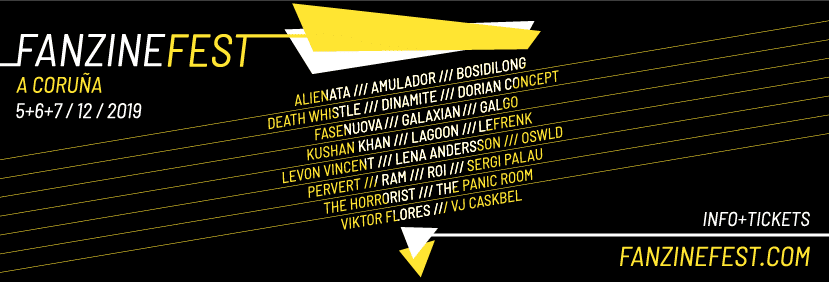
Fanzine Project will be back to A Coruña, in Spain, from December 5th to 7th for the 2019 edition of its ‘Fanzine Fest’ festival. With an eclectic selection mixing well-established artists such as Levon Vincent, The Horrorist, Alienata, Viktor Flores, or Dorian Concept to new musical and visual projects, avant-gardism is this festival’s keyword.
Viktor Flores is a Galician journalist and DJ known for his long residency and co-programming in the legendary club Vademecwm and as the founding member of SINSALaudio Collective (also promoter and festival). He flags the minimalist Central European sound, combining it with timeless classics from Chicago and Detroit, notes of Dub, Electro, classic Disco, EBM or Techno-Pop sound. He has made incursions into projects away from the dance floor and more experimental like Lost in Sound. For a decade he has presented the workshops of the RBMA in Spain.
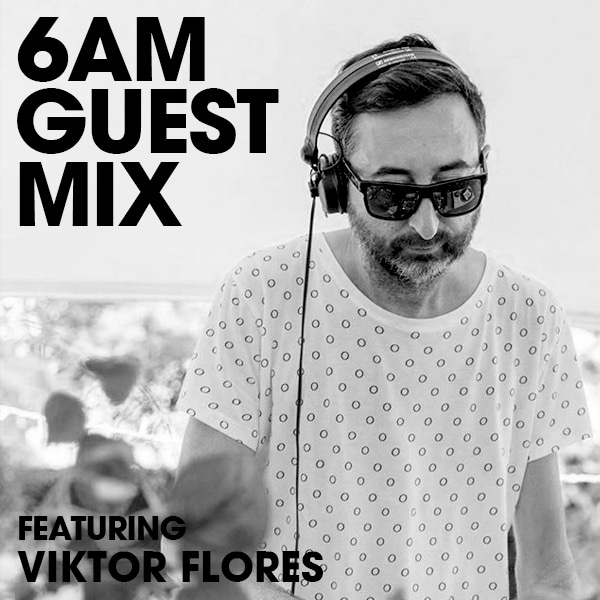
We asked Viktor Flores to provide a 6AM Guest Mix for our readers and listeners and grabbed a chat with him while we were at it. The mix is a live recording of a recent club set at Mondo in Vigo, proper signature Viktor Flores sound!
Thanks for the mix Viktor, what was your mood when you were putting this together and what mood do you hope it puts listeners in?
Thanks for inviting me to your Guest Mix Series! The initial plan was to record a home set with different music, maybe closer to what my set at Fanzine Fest will be, but due to several reasons had to change the plan quickly, so the final mix was recorded live in one of my recent club sets. It was recorded during the premiere weekend of a new club (Mondo) in my city, Vigo. Wasn’t sure about the kind of crowd that would attend, so prepared a lot of different stuff. And guess that this section of the set reflects it pretty well, as you have Disco, House, Techno, UK Garage or Italo-Disco, all in around 90 min! ;-)
Regarding the mood I hope it put the listeners in, let’s say that it would be nice if it helps to start the fire in a pre-club home listening session on a Friday / Saturday night.
Any particular stand-out tracks we can find in it?
There’s a mix of fresh and older stuff, as I like to play in all my sets: i.e., one track from 2019 mixed into another from 1980. Some of my favs are a floor killer track from Jex Opolis on Dekmantel, and old John Ciafone hard house track under his Chiapet moniker on Yoshitoshi. A massive Italo Brutalo edit from a Moses 80’s Italo-Disco track, an Experimental Products edit, a new Floating Points or a quite mental new Techno track from Fort Romeau.
Can we find any Viktor Flores tracks in this mix?
Unfortunately, not. Although I took some first steps in the studio time ago and have some drafts and unfinished tracks, never had the proper time to dedicate to a serious studio production process. So, I finally
agreed with myself that this is something that you don’t need to push if it doesn’t come up naturally, and decided to focus on my DJ sets, curatorial and promoter activities.
Can you tell us a little about how you first got into electronic music?
I was a radio boy since I was very young, always loved music. At around 9 or 10, got introduced into the published DJ mixes series from Spain in the mid ’80s (Max Mix, Bolero Mix series…), and was fascinated about this DJing ‘science’. Later, in 1988, I discovered a club in my city called Op Art, where they played Acid and Chicago House at the same time that House music was being initiated and built in the US, and went totally nuts with it. At that time, it was easier to enter a club being underage, so got totally amazed with this completely new world (the music, the crowd and the atmosphere –so avant-garde-), and quickly wanted to know more about DJing, music production, those artists and labels, etc. I started to follow the few existing radio programs and music mags about dance music at that time, trying to create home mixes with a crappy equipment, etc. But I didn’t start DJing seriously and had my first residency until I was
21. A bit late if you consider the usual age when kids start today…
Who were your producer/DJ “heroes” at the time and are they the same now?
My first and main influence was Chicago House. I loved those early Trax, DJ International, Cajual, Relief and Dance Mania tracks. Some of those raw, basic, acid or dirty and naughty tracks really captured me. Paul Johnson, Armando, Cajmere, DJ Deeon, Armani or Tyree Cooper were some of those heroes. That was in the late ’80s, early ’90s. Then, when I started to DJ seriously and at clubs, in the mid 90’s, I totally got captivated by the Dub Techno sound of the Basic Channel / Maurizio / Chain Reaction group. Also by the crispy, abstract sound of the Cologne scene (Profan, Studio 1, Auftrieb, the first steps of Kompakt…). I still play a lot of that stuff, never left my record-case.
I still feel respect for most of those artists. Unfortunately, some of them moved into a kind of mainstream electronic that doesn’t sound appealing to me at all. In any case, I prefer to focus on the idea that, after many years, I had the opportunity to meet and book them for some events organized by me, specially with Red Bull / RBMA (Moritz von Oswald, Larry Heard, Wolfgang Voigt, Dan Bell and many others that I never thought that would meet or book), so more than happy to have had this opportunity.
How is it living in Madrid for an electronic music artist like you?
I lived in Madrid for 12 years (2005-2017), same time that I worked for Red Bull Spain, managing the Culture Marketing Department, with projects like the Red Bull Music Academy, RB Music Studios or running festival stages. 2 years ago, I moved back to my home region, Galicia.
Those 12 years in Madrid were awesome, it’s a super-vibrant city. Maybe not so well-known as other club scene capitals in Europe, but with a healthy and exciting cultural and street life. There’s also some good labels, producers, a lot of small promoters and collectives and a few decent clubs. As always, the best options are in small clubs run by local collectives / promoters.
In Galicia, the scene is much smaller. We used to have a strong scene back in the mid 90’s/00’s, but after the last economic crisis in Spain (2010- 2015), mid-size cities, like Vigo or A Coruña never recovered the force of their previous club night scenes. Also, leisure and social trends changed a lot (this doesn’t apply only here, of course). So, we’re trying to rebuild everything now, not from scratch, but almost. There’s a lot of room to improve, but what we need most, besides promoter’s initiative, good clubs and programs, is people interest and their support.
How would you describe the local scene there? How involved are you with it?
In the last 4 years, I organized several club nights with my former partners of Certain Music, at Siroco and Berlín clubs in Madrid, with guest artists like Secret Sundaze, Francis Inferno Orchestra, Jayda G, Central, Vin Sol, Fett Burguer, FIT Siegel or Millos Kaiser. Most of them were great events, but as every small / independent promoter knows, it’s a lot of work and it’s always tough to achieve good results, specially from the budget/income perspective. We also took our club nights to other cities like Barcelona or Gijón.
Now, I’m more focused on music consultancy, artist management and programming the new era of a club called Mondo in Vigo, and booking talent for some small festivals. Also, concentrating on my own bookings
and club nights.
You’ve played a lot of great clubs and festivals in Spain. What have been some of your favorites?
Wow, that’s really a difficult question! 2020 will be my 25-years career anniversary, so there’s a huge number of festivals and clubs during this time, and thousands of miles travelled. At the moment, I really like Berlín Club in Madrid (great sound, venue and crowd), Passos Manuel, Plano B and Pérola Negra in our close and loved neighbor city of Porto (Portugal). Used to love to play at Moog in Barcelona. Also, Lanna in Asturias, Siroco and Ballesta Club in Madrid. And many others in Bilbao (a city that always loved and had good fun), Valencia…
Regarding festivals, my favourite one is Sónar (Barcelona), for many reasons. I played at Sónar 4 times, first one in 1999, and have great memories from all of them. They were the first ones, had a huge transformation and evolution throughout all these 25 years, are superprofessional and have a special eye to detect fresh talent and new trends.
They’re also friends, so have a special feeling for Sónar. I played at some of the major festivals around the country, but I prefer small or boutique events rather than the big ones. Like Paraíso in Madrid or Jameos Festival in Lanzarote (Canary Islands), a small event run by very passionate people, in what John Morales and others named ‘the best dancefloor in the world’, as it takes place inside a volcano cave. The feeling playing there is indescribable.
But I’ll always have a special place in my heart for Vademecwm, the Vigo club where I was resident and programmer for 10 years. I learned a lot there and lived some of the best moments of my career.
Viktor Flores performs at Fanzine Festival 2019
You’re playing one in La Coruna in about a month, what do you expect from it?
I’m really looking forward to it, it will be my first time at Fanzine Festival and new gig in A Coruña in a while. Super-excited for it and preparing a totally different set from the ones I use to play at clubs. It will be more complex, noisy, poly-rhythmic and bold, I hope. Also, waiting to meet some friends and see artists that I love (Levon Vincent, Fasenuova, Dorian Concept, Alienata…). And to discover fresh and new talent, especially local ones. There will be a lot of friends on the dancefloor, so waiting for the day to come!
Are music fans and parties different in the North of Spain compared to the South or Madrid?
Well, it always had been said that in the north fans liked it harder and faster, so in the 90’s all DJ’s from abroad knew that playing in Galicia or Asturias regions demanded more pumping and energetic sets. This changed a lot in the last years, obviously, and in most cases audiences accept new sounds and styles, or even demand it, after many years with House / Techno only options. Festivals like Fanzine in Coruña or WOS in Santiago de Compostela would have been unfeasible 15/20 years ago.
This reflects a change of mindset within the audience, but is also possible due to the hard and brave work of promoters like Roi and Pablo (Fanzine).
How different is the Spanish crowd to that of other European countries?
The topic says that we party like hell and that club attendants go nuts easily. It won’t be me who says the opposite! It’s true, we love to live on the streets (weather helps), go out to bars almost daily, meet people, socialize, talk (a lot) and then, quite (very) late, go to clubs and dance until dawn (at least). This is something that surprised guest international artists years ago, when they started to come here to play. That a regular club night started at 2 or 3 am but the club wasn’t packed until 4 or 5…
When you’re in your early 20s, that’s ok. With the years, you appreciate and envy other countries/cities, where you can be dancing on full swing at midnight. Also, and this is serious and not cool at all: in many places/cities here, you go to a concert and there’s a lot of buzz, because people are talking all the time, which’s pretty disrespectful for the artists, especially if it’s an intimate show. As a promoter, I experienced quite uncomfortable situations because of this. Then you go to Portugal, for instance, our closest neighbors here in Galicia, and the picture completely changes.
2019 is coming to a close. What lessons are is Viktor Fores taking from it?
2018 and 19 are being years of transition, after my move from Madrid to Galicia. I started to seek for new projects here (club nights, festivals, artist management…), and had to remind to myself that things here run on a different speed than in Madrid, for example. Galicians need 3 or 4 meetings and coffee time to chit-chat and 3 or 4 more to start executing ;-)
Also, as pointed before, club scene is not living its best moments here, but instead of complaining, I prefer to see an opportunity rather than a threat. So, still a lot of room to improve and create new things. And despite all of this, there’s a bunch of talented artists, collectives and promoters that are struggling to create something fresh and with consistency again. Collectives like Dial, Retrofuture, Under the Ball, Certain Music, La Melona, Qué Facemos, Flop and Tentacle Festivals, Mondo Club and many others are working hard for it. And, especially, festivals like Sinsal, WOS or Fanzine. You need to be very brave, and even a bit reckless, to produce events with the approach, concept and line-ups like these ones. Nothing to envy to other major festivals in biggest cities in Spain, so thumbs-up to all of them!
What do you hope to achieve in 2020?
Keep being involved in this industry: DJing, launching events, supporting other artists careers, co-creating concepts and marketing strategies for festivals and events… Organize some cool events for my 25 years DJ anniversary and, at the same time, create and launch a new music project besides ‘Viktor Flores’. So, not nostalgia at all and yes to look forward to the next 25!
Tickets to catch Viktor Flores at Fanzine Festival are available HERE
Connect with Viktor Flores: Facebook | Mixcloud | SoundCloud


