
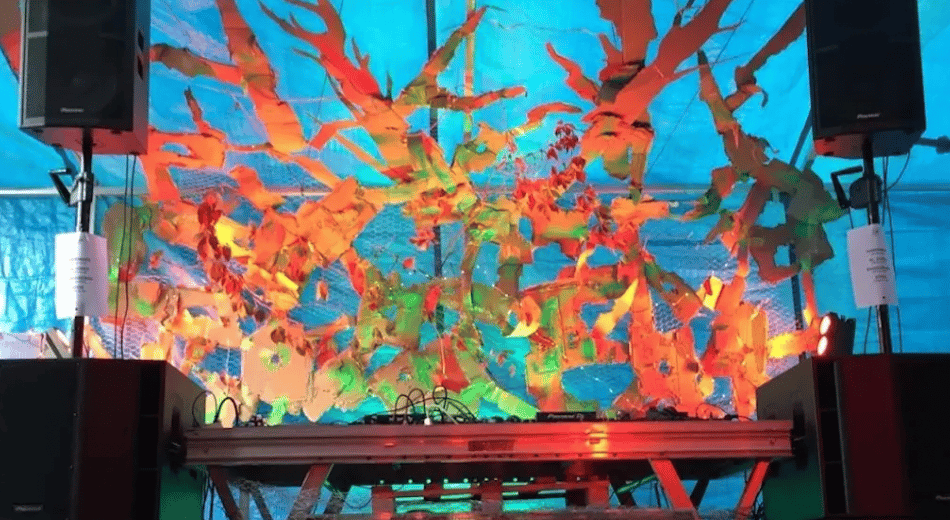
Milan’s party scene is thriving in unconventional spaces.
Clubbing in Italy has faced several challenges in recent years, chief among them the Covid-19 pandemic. According to Il Sole 24 Ore, one in five clubs has closed since 2020. But now, with people finally back on the dance floor, promoters have been experimenting with new formats and venues.
This is especially true in Milan, where the underground scene feels more vibrant than ever. A former industrial giant, the northern city is home to many empty spaces that are ideal for parties, especially on the outskirts. As traditional venues grow ever scarcer, promoters are throwing events in parks, warehouses, art galleries and beyond.
Off-location events aren’t new in Milan. Queer party Vitamina, which has hosted daytime events since 2016, currently runs at a bicycle repair workshop in among nature on the periphery of the city. The promoter Giorgio Bertaia, AKA Kingsizebed, explained how the operating hours were a driving factor behind choosing the venue.
“At clubs, people don’t show up before 1 or 2 AM,” he told Resident Advisor. “Everything feels rushed, there’s not much time before the club closes at 5 AM. It’s hectic. In other types of locations closer to nature, we can plan events during the day and create a completely different experience. People show up alone, to socialise, which doesn’t happen in clubs.”
Sabotage, a party focussed on Black music, recently came up with a similar solution for night-time events. The parties take place in Arci Bellezza, a disused gym where the 1960 classic Rocco e i suoi fratelli was filmed. This space is part of a cultural hub usually hosting talks, live concerts and neighbourhood meetings. After the pandemic, Sabotage noticed a growing number of promoters heading to non-conventional locations. When the clubs reopened, many of them were overwhelmed with promoters’ requests, and there wasn’t space for everyone.
But the lack of available dates is only one factor pushing promoters, many of them younger, to find new spaces. Velardi, who cofounded Opal with Vittorio Valigi in a small loft in the industrial Lambrate area in early 2020, said the party never really intended to work with clubs.
“If you get into a club’s dynamics, numbers become more important than the cultural proposal,” he said. “We think it should be the other way around. We started selling records [at the loft] with